02 January 2015

Italy In the Dark

Alongside hot yoga, In the Dark Radio has been one of my great passions of 2014. 

In the Dark Radio is a mini-revolution in radio, in listening - we curate themed listening events, creating audio programmes of the world's most innovative radio makers & producers. 

It started out as a group in London. Late last year, a friend and I started running it in Manchester - and early this year, when he left to try out great big London for himself, I had a choice: run In the Dark Manchester on my own, or let Manchester, this brilliant city, continue existing without it.

I kept it going on my own and ran 6 events through the year. It was a lot of work, but now, it's changing & growing & getting even more exciting. In the Dark Manchester is now a proper group, with, you know, more than one member.

And In the Dark has been kind to me, as well - not only did I get to go to my first ever British music festival (Latitude), but I also got to attend & present some of our favourite international audio pieces at the Internazionale Festival in Italy - an incredible treat. 

I hadn't been to Italy since I was a child - back when you bought things in lira. The festival was from 2nd-5th October - since the last day coincided with our first wedding anniversary, he decided to come join me in Italy - and we made it into a week-long celebration! (That part will be in another post, coming soon...this post is just about the festival.)

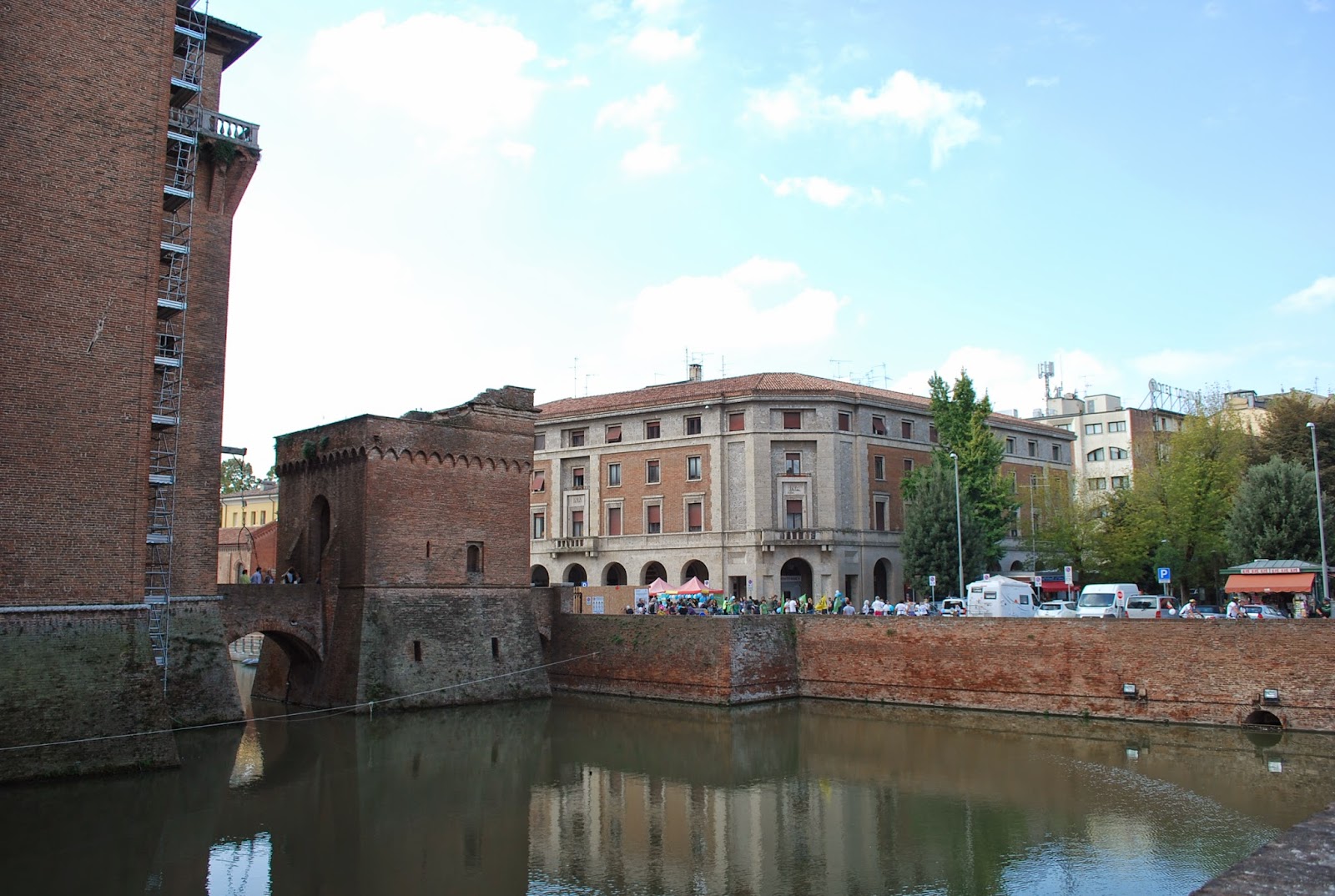
The Internazionale festival was in Ferrara, a little town I'd never heard of before, with a blocky domineering castle in the middle of it. The festival was in this strange castle (note the actual moat!) and our In the Dark events were held in the dungeon!

This was the dungeon, where we held our listening events. The water in the moat was just visible through the gated, arched windows. 

The pieces we played out were perfect for the event - both involved multiple languages, both involved the tricky am-I-being-understood feeling that takes over when you're in a new country, with new people. My favourite was by Katarina Smets, Senza Parole.

The only downside to Ferrara - the only thing that stops me moving there just about now - are the mosquitoes. I'm not even sure they are mosquitoes. They are giant flying bugs, possibly military drones, that bite you (me) with all the righteously true aim of the vengeful. They hate you (me). They keep you (ME) up at night, flying at you (ME ME ME oh god ME), like some kamikaze mote of dust, and bite, over and over and over again. 

Needless to say, I spent my days in Ferrara slightly tired, scratching my ankles & I spent my evenings... not getting great sleep. 

FUN FACT: Enzo Ferrari, the guy who, you know, invented the Ferrari or something, is actually from Northern Italy, very near Ferrara.

The festival treated us really well & I made some new friends in Italy. They put us up at a little church-turned-hotel, with this view every morning.  


The Internazionale Festival is a journalism festival, run by a magazine of the same name. In the English speaking world, we often feel like our media is half-baked, whether it's 24 hour news always chasing the bloodied victims of some horrific event, or it's local news, proclaiming the newest excellent thing to happen to our lovely town.In Italy, though, the newspapers almost exclusively cover Italian politics. As in, front page - Matteo Renzi (Italian Prime Minister). Pages 2-8? Italian Parliament. Meanwhile, stories about international issues, like say, ISIS  - flounder in page 9, if they get covered at all.Internazionale, the magazine, was founded partly to fill this gap in Italian journalism - and the festival is largely about bringing Italy's journalists together with the international experts - to try to give these other stories some room, some awareness. It was a little bit shocking for me to realise that in this Western European country, even many journalists wouldn't have seen a documentary about Rwanda. Jonathan Zenti, one of the festival organisers, told me that he just reads the Guardian, rather than even looking at Italian news sources - which is fine for him, as he speaks/comprehends English really well. He didn't seem to think all Italians got their news elsewhere, though.
Given the choice between watching documentaries on human rights tragedies or wandering around a warm Italian city in the sun, I think you can guess that I spent nearly every day just wandering around Ferrara's gorgeous little alleyways. Occasionally, I stumbled on a park. 

As I wandered, I listened to Lea Thau's 'Love Hurts' series on the Strangers podcast, an intimate peeling and prodding and untangling of love & relationships. (Go listen now).This is the Palazzo Dei Diamante, which I read about one morning, before heading out to find it. I translated with my non-existent Italian, in my head: "Palace of Diamonds! Covered with marble & 8500 diamonds - sparkly!"When I found it, I realised that actually, it is an entire facade of pink & white marble, carved into 8500 diamond shapes.

It is actually a breathtaking and impressive building - it can only be a disappointment if you, like me, thought there would be 8500 diamonds stuck to a building, which had somehow evaded pillaging. It can only be a disappointment if you, like me, are a little bit dim when you're in a new place, slightly tired from nightly bloodletting by  mosquitoes that might well be weaponised military insects full of vengeance. 


Some friends of Jonathan's made sure to show me & Nina (director of In the Dark) a good time. Ferrara is very proud of its local food. Martina (a resident of Rome) insisted we try a Ferrarese delicacy - pizza with a chickpea flour crust, called pizza ceci in Italian. It was decadent & luxurious. Chickpea flour has an amazing capacity to take in oil & butter & become crisper and more delicious. 

I'm still looking for a decent chickpea flour crust recipe - it would be the perfect experiment for Jonti (whose sourdough pizzas are brilliant already). I also enjoyed some other Ferrarese seasonal delicacies: capellacci di zucca, which are little pasta 'hats' stuffed with butternut pumpkin. More stuffing than ravioli, due to the hat shape & more delicious than most stuffed pastas, due to the pumpkin! Now that Jonti and I are finally getting the hang of our new pasta machine, I think these will become a staple round ours.

Ferrara is surrounded by rambling Italian countryside, dotted with crumbling farmhouses. Jonathan and Martina told me that in 2012, there were earthquakes in Northern Italy that caused a lot of damage - the region is still recovering.

It really is a lovely place. Once you get only 10 minutes from the castle, the whole place feels like a ghost town - quiet, narrow, warm streets, with shuttered windows & a yellowy, old-feeling stillness. 

I think these were the city walls. 


I really liked Ferrara. And, listening to Lea Thau's gentle examination of what it means for us to be strangers and try to connect with each other, I couldn't help thinking that there is something similarly gentle about these empty streets where I, too, was a stranger. 

21 December 2014

America - Part 1

After a long hiatus, this post is authored by Jonti – he's written some memories of our first trip to the States.

...

First I gave Nija a tour of Washington D.C., her nation’s capital.

Now she’d like me to write on her blog about our trip to D.C. and Atlanta together – which I am delighted to do.

When we first met, many years months ago, we were both excited about exploring and re-discovering Manchester with someone else. To see the city through their eyes. I found Nija – a non-Manchester native – who loved Manchester even more than me and during about 18 months – through dissertation-writing and job-hunting and a wedding – we did exactly that: re-discovered this northern city through each other’s eyes.

When we first met, I could not imagine that we would re-discover Atlanta, her home city, together too. Finally, this August we went for our first trip. Here are a few impressions.

We stopped off in Washington D.C. to visit Nija’s grandmother and her Aunt and Uncle.
Here is Nija with Ba.


By day, we wandered around the monuments walking off our jet-lag. I had been a couple of times to Washington and was a hardened Mall-walker. Nija hadn’t really spent any time there so I gave her a tour.


The Washington Monument had recently re-opened following the 2011 earthquake


Nija also showed me some things I hadn't seen before, at the botanical garden.


Of an evening in suburban Maryland, we would enjoy the company of Nija's family. They were incredibly generous & I had my first taste of gargantuan American restaurant portions. A salad is not a light option.

***

We flew down to Atlanta. Airport security was fortunately relaxed about me being ‘Small’ on my ticket but now a ‘Dalal-Small’ in my passport.

By the time we got to Atlanta we were on the right time zone and I was ready for my first Indian cookery class. Tanvi and Sanjay, Sahil and Sahana, all came around to Nija’s parents. Nija's mother cooked Dal Makhani (lentils, black lentils) and I tried to help.

Throughout the two weeks, we ate very well. Most spectacular was lacy lentils. (khandvi!)
This involved thinly spreading out a paste made of yogurt & lentils, and cooling it over the table.

Here they are laying it out:


With all the eating so well, it was lucky that the neighbourhood swimming pool was just a short walk away.

I could also play tennis with Nija's niece & nephew (reassuringly, even though they had recently won a state-wide competition, I was able to emerge victorious – though not, I suspect, for long).

I’d been warned that Atlanta is a very car-friendly city but one wonderful highlight was an antidote to the car – the late-summer lantern parade. Taking place along and celebrating the Beltline – a walking, cycling, running route which is gradually being opened up – we stood in the warm early autumn evening and watched the thousands of creative lanterns.


Also to stretch our legs we went to ‘hot’ yoga (somewhat strangely, given the sweltering Southern heat outside. In fact, it wasn’t all that hot – at least not as hot as Northern England’s hot yoga.)

The studio was in Marietta – the closest, quaintest town to Nija’s parents –  where the old library is now a flower shop and a vintage cinema shows re-runs of To Kill a Mocking Bird. The general store stocked wine glasses made out of old bottles and had a fridge of local craft beer which we’d take back and drink of an evening sitting on the deck with Nija’s parents.

During yoga, the railroad rattled past, shaking the walls. The showers were in the process of being built – sometimes noisily to accompany the serenity of the class – and one of the teacher’s hamstrings snapped once – but we had a fabulous time.  Best of all at the studio, we encountered people who were just extraordinarily thrilled that we were there, in their town, in their studio.

Even riding around in the car we were always entertained. I’d been told about the ‘big chicken’, a towering KFC landmark.


However my favourite was this restaurant, a fish place that seemed not to mind implying that this was the place to gobble up Flipper –


It was a wonderful trip – this is just a taster. Part 2 is coming...

17 August 2014

Latitude!

I guess America does have a lot of music festivals - but they seem to me, at least, to be a particularly British thing to do. To go, for several days, to a huge campsite, and sleep in tents only feet away from other people sleeping in tents... it's something I never did in the States.

I tried, once, in Australia, and failed miserably.

But British people love a festival. I know several who will spend hundreds of pounds, on a single festival ticket EVERY YEAR to go to Glastonbury - which, remember, is 5 days long. Your food, drink, travel there and back...  are not included in the ticket price.

This year, I was invited to go to Latitude Festival as an In The Dark Radio performer.

In The Dark Radio is a collective of radio enthusiasts (you know, people like me!) who run listening events. I've been running it in Manchester for a few months, now - it's a great way to make other people geek out on radio.

Jonti and I approached it as a sort-of-cheap holiday. I had to do some hours at the In the Dark hut, he had to buy an actual ticket, but other than that, I definitely recommend Latitude.

We organised a car-share to get there with some strangers. That could have gone poorly, I suppose, but we got lucky. Annette & Sonu are people we'd actually like to be friends with.

We got our lovely new tent up the first afternoon.


The sky over Henham Park, in Suffolk. Latitude is in one of the many beautiful parts of England.

The In the Dark Radio hut was built by an artist collective called Morning.

You are not supposed to squat on the swings like this guy did. You are supposed to swing gently and listen hard to the excellent radio we play into the hut.


I'm sure I do not need to tell you why this is adorable. I'm also sure that you, too, despair at the Oxford Online Dictionary's decision to include 'adorbs' as a word.
It rained a bit on Friday night, but by the time we were festivalling again, the rain had drained away.At some point on Saturday, Jonti and I needed some time alone together, not with 35,000 other festival go-ers, and we headed back to the tent just to get some quiet alone-time. When you are willing to lay in a boiling hot, bright, humid tent in the middle of the day, you are in serious need of quiet alone-time.
On Saturday night, though, there was an enormous storm. Because we had a lovely new tent (see above), the storm was intense, but it was not in tents. LOL.We had scheduled a late night 'adults-only' radio session on Saturday night - Nina, the director of In the Dark, had it on her laptop & iPhone. As we all showed up at the hut, shivering and soaked through, we tried to plug in Nina's iPhone. It was water-damaged and wouldn't work. We tried to plug in her laptop. It didn't really want to work. Finally, we got the night playing, but our hut was just filled with drunk people sheltering from the storm. They didn't want to hear it. We wanted to get back to our tents, get dry & get into bed.We stopped the event early. Thank goodness. I trudged back through the mud and rain, hoping the tent was dry, and not entirely sure that I would sign up for a festival again, to be honest. But apart from the storm on Saturday night, we were lucky with the weather. 
And we got to see and do some very fun things. One of our favourite bands, Future Islands, played, and we got right up to the front row. Hozier & Haushka, both bands we hadn't heard and fell in love with... We saw the Royal Shakespeare Company do Revolt, She Said, Revolt, which was powerful and incredible.We saw Arthur Smith do his comedy/storytelling bit with Leonard Cohen songs, and it was truly wonderful. Until the bit at the end where a grown man came hopping out of back stage with a mask on and nothing else. Until that bit, I was very charmed by this show... And Jon Ronson gave a quirky Jon Ronson-style talk.As we were packing up the tent on Monday morning, I thought, yeah, I'd probably do it again. Bring on Glastonbury!--Side note: This time next week, I'll be visiting you Atlanta lot. Get ready! I can't wait to see y'all! I can't wait for you to meet Jonti! 


14 July 2014

This One Night: True West

Or: Another Blog Trail!

First Draft is one of Manchester’s excellent monthly events – it slants toward theatre, so it’s slightly different to the literature & story-heavy nights I often go to. Abi & Rachel, the organisers, invite performers of all stripes – theatre, yes, but also comedy, music, literature – to try out material early, before it’s polished, before it’s perfect. It’s not for some sort of art school-style submission to criticism from the group – rather, it’s because the first draft can be the most exciting draft.

It’s the draft that, after months of re-drafting and cutting and adding and cutting again, ends up actually being 2 stories & 1 novel & 3 other stories besides which really belong in the bin. It’s the hit and miss draft. Or sometimes, it’s just the miss draft.

For example:

Abi’s invited me to do a few First Draft nights, and I’ve found them really useful. My first time, I worked very hard on not working very hard on the story I was telling. I wrote the story on a Sunday, walked onstage on the Monday and read out the first draft of my story almost completely unedited.

It was the fastest I’ve ever given up on a story in my life. Ordinarily, if I’m writing a story, but it’s not working, I wrestle with it for weeks or months before I’ll finally admit there’s something wrong with how I’m writing it. It takes me ages to think maybe I’m trying to stick too many stories into one, or layering too many wonky metaphors... and only then will I leave it to be picked over for scraps to weave into later stories. But getting up and reading that story – out loud, to strangers & early – made me recognize it for what it was. A miss draft.

ANYWAY

The lovely folks over at First Draft have expanded on the ‘This One Book’ blog trail, which keen readers will remember from this post.

They invited me to contribute to their ‘This One Night’ blog trail, wherein, I will tell you about a live performance that has been significant to me. Read the first installment of “This One Night” on the First Draft blog, a beautifully told tale of Abi’s first Macbeth.

Here I go:

Until very recently, live performance, especially theatre, has never held much interest for me.

Partly, this is down to Bob-Fosse-based trauma (“Oh, no, they’re coming off the stage. Into the audience. No. Oh, please don’t throw the glitter at me… Oh, no. Oh, please, please oh the spandex. Oh, no no no.”)

And terrible musicals.
Image from: www.goodspeed.org/productions/2006/pippin


Don’t get me wrong: I’ve seen some amazing productions. Kenneth Branagh’s Macbeth in St Peter’s for the Manchester International Festival was brilliant. Daniel Kitson’s Tree: stunning, funny, harsh. The Confederacy of Dunces: fantastic. As a kid, I really flipping loved theatre magic. My sister once made the mistake of taking me to a Penn and Teller show – I spent hours that night telling my parents what the tricks looked like, in an attempt to figure out how they worked. Magicians will tell you: that is the wrong way to go about it. What a trick looks like has nothing to do with how it works.

Generally, cinema has been more my style. Cinema feels more immersive – the camera follows characters, rather than characters presenting themselves on a stage. I like edits: I like that I don’t have to actually watch a character storm out of a room and slam the door. I like that the actors won’t notice if I think it’s terrible and walk out halfway.

ANYWAY

Jonti & I had travelled to Glasgow to see it at The Citizens Theatre – one of Jonti’s best mates, Phill Breen, was the director. Jonti had told me Phill was amazing. I was expecting something rather theatre-y.

The curtains opened on True West. I gasped. For the next two hours (or so, I can’t remember how long it was) I forgot that I was watching a stage, that there were real people presenting themselves as characters on a stage & that walking might ever be a thing I would want to do again.

Image by Pete Le May petelemay.co.uk


I just watched, transported, immersed.

Written by Sam Shepherd, True West is the story of two brothers – one an uptight do-gooder and the other a complete disaster – who are pent up in their mother’s house for a weekend. The do-gooder tries to write a play. The disaster, with no small threat of violence, horns in on the play. The do-gooder eventually loses his shit and nearly strangles the disaster. And then their Zoloft-happy mother comes home.

Throughout the play, Breen ratcheted up the tension between the brothers to unbearable levels – the house seethed with neuroses, thinly guised contempt and frayed tempers. The stage design, which included a ceiling, floor and three full walls, made the house feel claustrophobic & airtight.

I’ve never seen a ceiling built onto a stage before. Usually, lighting rigs are up there. The ceiling enhanced the claustrophobia, but it also meant Breen’s lighting designer had to get damn creative.


The actors made deeply flawed characters sympathetic & simultaneously unlikeable.

And somewhere between the staging, the lighting and the acting, this play became cinematic. It took on colours I’ve never seen on stage before.

I’ve never seen a show like it.

As we left that night, I told Jonti, “Your friend Phill is some kind of genius.”

Oh, oh, I cannot express to you how it gripped me.

Maybe that’s because I keep telling you what this show looked like.

Let me instead tell you this. After seeing True West, I couldn’t sleep for hours. I was – and still am – trying to figure out how it worked.

BREAKING NEWS:

From 4th September to 4th October this very year you, too, can see the brilliant Phillip Breen's True West at London's Tricycle Theatre.

YOU. LUCKY. PEOPLE.

Get your tickets now.

08 July 2014

This One Book: Lolita

John Gall's original cover design for the Vintage edition,
 reissued in 2005.
This cover design was never used - it was too suggestive.


Recently Dan Carpenter started a blog trail (over here). He shared the story of a book that changed how he thought about books and writing, when he was around 14 or 15. And he invited two other bloggers to share their stories of the books that changed them as adolescents.

The idea was based on the formative nature of our early teenage years & how, sometimes, a book read at the right time will shape the way you think about books and change your brain forevermore. It’s certainly true that some books must be read at a specific age or time in your life to mean much to you. I read Fahrenheit 451 in my 20s – it was way too late & I found it adolescent & tedious. I read Animal Farm when I was 12, and I was like, ‘WHOA. SATIRE.’ I’m sure it wouldn’t feel like that if I were to read it again.

Simon Sylvester & Dave Hartley took up Dan’s challenge – and Dave invited Ben Judge and me. I have taken quite some time thinking over this. Because, while Animal Farm introduced me to satire, it hasn’t really affected how I think about literature or as a writer. Trust me, I am no satirist. And as an adult, many books that I’ve read have influenced me & changed how I think about literature (Kavalier and Clay, House of Leaves).

But I’ve been trying to nail down which book deeply affected me when I was a young teenager, when I was 14 or 15. I wasn’t able to just run a finger across the spines of my book collection – at this point, my book collection is scattered across two continents, in 3 basements & a seriously overstuffed bookshelf. Oh, and some are propping my bed up to keep it from breaking. Seriously.

Here’s the thing:

As a teenager, I was in advanced literature classes throughout high school (ages 13-17). For the first year, it was fairly easy going. We read a lot of shortish novels (Heart of Darkness, The Metamorphosis, The Portrait of Dorian Gray) and extracts from longer novels (Great Expectations). We did a few weeks on poetry & a few weeks on grammar. I loved the few weeks of poetry. I loved it so much I tried to write my own poetry. I loved the alliteration & clever tricks of language. But my poems were terrible. I had to stop writing poetry.

And then shit got real.

10th grade: we read a novel every fortnight & wrote a paper on every one. (The Great Gatsby, The Crucible, Death of a Salesman)

11th grade: we read 10 Shakespeare plays & wrote a paper on every one. Some of them were easy (Romeo & Juliet, Twelfth Night). But some of them weren’t (Richard III).

12th grade: we read a novel every week & wrote a paper on every one. (Crime and Punishment, Catch-22, The Grapes of Wrath, Tess of the D’urbervilles)

We had reading lists for the summer holidays (usually about 6 books) and a paper was due on one of them for the first day of class. I had 6 other classes to attend every day, with their own Advanced Placement statuses & their own ridiculous amounts of homework. To clarify: AP Biology, AP Spanish, AP History, as well as 12th grade maths, chorus & another class that I don’t remember now.

This sort of education ensures that I have read more of the ‘classics’ (don’t let’s start) than many of my British peers. It ensured that I easily earned highest marks on my Advanced Placement exam – I got really good at reading & comprehending vast sections of text quickly, picking out a major theme, finding a few quotes & passages to back up my argument about said theme, and writing a paper about that book damn fast. I still appreciate this education – I like having the skills to understand the book behind the plot. But it came at a price.

By the end of 12th grade, I could read a book and analyse a book within 2 hours. In fact, I was analyzing it as I read it. I never properly read a book; I was just sifting through them for themes/passages/quotes that I could use for the paper I’d have to write the next day.

Many of those books affected me deeply – I have re-read some in more recent years – and I still find them moving and wonderful and resonant. But at the time of first reading, I was simply a bulldozer, ploughing through words, powered by a relentless curriculum.

It wasn’t until later – the summer after high school, I was nearly 18 – that I got my ‘this one book.’

Nabokov’s Lolita

That summer, for the first time, I had the leisure to read, re-read, absorb and truly relish my reading – but not all the books I read that summer (ahem. Harry Potter) mattered like this one. For Humbert Humbert and for me, Lolita changed everything.

-----

Well-spoken, well-written English is revered round my house. I didn’t start saying “y’all” and “ain’t” until I had moved out & was nearly 20 – it was a quiet rebellion, as I slowly allowed my mouth to take in and form and create the Southern accent & colloquialisms I’d never been allowed to have at home.

Perhaps well-spoken, well-written English is revered round my house because my parents were born just as the British were wrested from India – and empire has a slow way of diminishing in hearts and minds, if not in land and influence. English, I remember being told, is the most expressive of all languages because it has more words than any other language & whenever it doesn’t have a word for something, it gladly makes one up.

Or maybe well-spoken, well-written English is revered round my house because it isn’t in great quantity. We are a bilingual family and it seems our English is all mixed up em-thhem Gujurati ne Hindi sathe. Though English is not my first language, I did well at school & I’ve never had much trouble with English – but I never thought I’d be able to write it all that well. I had one too many languages in my head & being able to write well meant, in my mind, knowing one language (preferably English) extremely well. To write, one must be expert in English – to be expert in English, one should probably not have a Gujurati/Hindi-based confusion between, say, ‘turn off’ and ‘close’ or between, maybe, ‘tall’ and ‘long.’

(I regularly ask my husband to close the light & I often notice, in passing, that that stranger across the street is very long. He must be at least 6’6”.)

But then. Lolita.

From its first poetic sentence to its first-person oh-so-entirely-unreliable narrator to its achingly, head-shakingly clever tricks of deception, etymology & pronunciation, Lolita had me. 

With its repetition, its way of playing with the Russian sounds in English words, its crafted, lyrical language, Lolita had me.

Nabokov became some sort of multi-lingual hero to me. He apologises, at the beginning of the book, for any poor English he displays. English, he explains, is not his first language. He apologises, in essence, for using English better than most monolingual writers of English.

Lolita taught me that I could be poetic without being a poet, and I could write well even though I was bilingual – that in fact, being bilingual might even help.*  **

I know Nabokov affected my writing, though I didn’t start writing until over a decade later, because I still recognize my rather unsuccessful attempts to emulate his lyricism and cleverness.

Lolita affected my reading, too – for the first time, I enjoyed a ‘classic,’ lingering over the pages, marveling at this particularly clever little rhyming dance, sighing over that lovely turn of phrase, wistful and envious of the author’s skill. Humble humburger and I were entirely unprepared for Lolita’s magic. I’ve never felt beauty in language quite like it again.

Lolita changed everything.

-------
To keep the blog trail going, late as I am to it, I'd like to invite 
1. Trisha Anne Starbrook, one of my American co-conspirators in Manchester
2. Fat Roland, because I get the sense that once that guy learned how to read, he pretty much just couldn't effing stop.

-------

* In fact, I later learned Nabokov was fluent in approximately 6 languages. I began to despair. “One could,” I thought, “do these things, but perhaps only if one was Nabokov himself.

** Don’t worry, I’ve recognised all these nasty vestiges of imperial thought & gotten them out of my head since 1999, when I first read Lolita. 


24 May 2014

How Strange It Is To Be Anything At All...

Neutral Milk Hotel have been one of my favourite bands for years. The sound of Jeff Mangum's voice always pulls me back to those late summer nights of 2005, when I would turn up 'In the Aeroplane Over the Sea,' close out the till, gush buckets of water across the coffee-stained floor, mop up the gritty grounds with bleach and hot water, and wonder where the hell I was going to end up in 10 years...

I remember those days, feeling lost. Like I wasn't doing anything useful... like I wasn't useful.

And Neutral Milk Hotel gave me something, every night, a wisp, a thread that held my heart together, those nights when I hated myself for losing time, every night, to this goddamn mop bucket.

The band had already broken up, by the time I heard of them, so I never thought I'd see them live. Jeff Mangum, for some time, seemed like he might never pick up a guitar again. 

But then he did. And the band reunited. They came to Manchester last week. Back in 2005, when I wondered where I'd be in 10 years, I never imagined the strange answers that have become the true ones: in Manchester. Working at the BBC. Married. Or married, but to someone that - back then - I hadn't even met yet.

How unbelievably my life has changed. How strange it is.

The show was amazing. It made my heart swell. It made me so glad to be alive, in this time, in this place. How lucky I am to get to see Neutral Milk Hotel in the Albert Hall, a perfect venue for them, big and beautiful, with stained glass and a huge organ.


For the past few months, I've been involved in this contemporary theatre project, called "Summer." It's not a play, but it is a performance, and honestly, I'm not really sure what it is - except that it is about being alive and about just being.

I'm one of the performers, along with about 30 other people, who are all different ages (the youngest is 18 months old, I think, and the oldest person I've met in it is in her 70s).

This is Cristina. She's in Summer, too.


Rehearsals have been strange, but in a fun way - a lot of walking around and working out how to interpret the sometimes-strange instructions they give us ("Walk, sit, run, lay down, or jump in lanes. When I tell you, you can walk, sit, run, lay down, or jump in grids.). For the photoshoot, they threw water on us. It is sometimes a totally ridiculous way to spend an afternoon... you can read more about it on Creative Tourist.

All Quarantine ask of us is to be ourselves - and the performance is based around all of our personal stories & lives. Between the Neutral Milk Hotel show and Summer, I've found myself daydreaming a lot this week - going over memories of summers past, who I used to be (quite hard on people), and who I still am (quite hard on myself).

Jonti and I have been packing all of life into our evenings. Apart from Saturday rehearsals & work, we have seen 2 concerts (Neutral Milk Hotel & Benjamin Brooker) and a play. On Tuesday, we went to Aumbry, an amazing restaurant near Manchester. We had a five-course tasting menu, and it was stunning. One of my dishes was too salty, but apart from that, it was absolutely delicious and surprisingly unfussy food.

That night, Jonti and I talked about being friends to people and building friendships with people, and being hard on people and being hard on ourselves. He said to me, "With friends, there will always be moments of good will, and there will always be moments of ill will. There will always be moments of cruelty and moments of kindness. That's what we do."

How strange it is, how lucky I am, to be married to this amazing man, who has so much empathy that he sees even ill will, even from his friends, as part of the flow of life.

11 May 2014

Elfin Ears!

It's been another long while.

Sometimes, it feels like I have so much to tell you all about, I get overwhelmed by it. And I avoid writing it. And then more happens that I want to tell you. It's a vicious cycle.

I apologise. That's just a cliche. This cycle really isn't all that vicious. Because it's a blogging cycle, and really, it can't get vicious.

Since I last posted, my family came to visit me. The big six: my mom & dad, my sister & brother-in-law, my niece & nephew. It was really important to me that my sister saw Manchester, my new home. I've been in this town more than 3 years now - and I'm glad she's seen it.

It was 10 days of Dalal-Parekh craziness, made all the more fun with some extra Small action. Jonti's parents rented a massive cottage in the Lake District and took us out on some walks.

Looking over Lake Windermere in Ambleside.
Dramatic skies.

Alan, Jonti's father, took us all on a walk out to Rydal cave.
We saw bats. We think


There is a strange British obsession with horrible American foodlike substances. I suppose it's because things like aerosolised cheese can't legally be sold as food here. They brought Easy Cheese for Jonti's cousin Philip, and my friends Neil & Joe. Look how happy it made Joe.
Joe eating a gross thing
and very happy about it.


This trip was the first time my sister met my husband.

I still think that's a really strange thing. I never never thought I would have such a tale to tell.

I still feel bad that she wasn't able to be at the wedding. I know we're going to have another one in Atlanta. But I also know it upset her. And I can't fix it, of course, because it's happened.

I was happy to see all of them - my niece and nephew are growing up and that's awesome and weird. But more than anything, I was really glad that I got to see my sister. I feel like I broke that secret pact we made when we were little, that pact where we said, "I promise I will not let you miss anything."

We didn't make a pact. But I still feel like I broke something.

-------

They flew out on a Tuesday morning - and that night, Jonti & I went out to see Mark Z Danielewski do a Q&A. Danielewski is the author of House of Leaves, a book that will change how you think about books in a good fun theoretical ambitious critical excellent way.

He's the kind of writer who attracts PhD theses like banana-eating attracts mosquitoes. It was a strange Q&A, as his fans lined up to ask him questions about how obscure French theorists inform his work. And he answered with grace and intelligence, shifting from an incredibly theoretical question to a profoundly human answer. He said things like, "When people ask me how I know a book is done, all I can tell them is that ... it's when the story starts to eat itself."

I loved this night. Benjamin Judge & Dave Hartley have written fuller reviews.

-------

We had lovely weather for the Easter holiday earlier this month. Jonti & I tried to go for a countryside bicycle ride, but we failed at that pretty miserably and ended up pushing our bikes up a seriously steep hill on an A road, riding along another A road, and eventually realising we had no idea where the track we were supposed to be heading toward started. It wasn't a total wash, though - we sat in Mossley park, in beautiful sunshine, warm and bright & we read our books and had a lovely picnic.

The next day, Katherine decided to drive us out to the beach! We went out to Formby and had *another* picnic! I know. Two picnics in two days. I'm totally spoiled.


I feel that because I grew up in landlocked Atlanta, I'm still kind of a kid at the beach. Water, the seaside, sand, seashells - these things are all still really surprising to me. Yes, I spent two years living in Sydney - but I didn't spend much time at the beaches. In my experience, most of Sydney's beaches were too busy & the water was too full of used tampons.

Katherine and Jonti walked ahead of me, as I constantly stopped to pick up seashells. Muttering to myself, "Oh, that's a pretty one... I wonder what animal this is??... This one has a hinge... Oh, neat." Occasionally, I yelled. "JONTI! WHAT'S THIS ONE?"

He would slowly walk back to me, take the shell from me, and quietly say, "I don't know. It's just a shell."

He spent his childhood coming to Formby regularly & he's totally over the shells. So's Katherine. But I took a whole bunch home and washed them and I'm going to keep them forever. Well, probably more like for awhile.


Near Formby beach is a red squirrel sanctuary. Red squirrels are indigenous to Britain. They have been losing habitat and food to the invasive species known as the North American grey squirrel... in other words, because of squirrels that are from where I'm from.

It makes me sad, because I love grey squirrels. I love their bushy tails and their awesome jumping skills. When they stand up on their hind legs, they look like they're wearing little white shirts. I love them. But here, in the UK, they are a bad thing. I was hoping that red squirrels wouldn't be as cute in real life as grey squirrels, so that I could go on loving the hell out of all the grey squirrels I see in Manchester. For cuteness.

But then, I saw three red squirrels in the woods near Formby Beach. And oh my god, they are even cuter than grey squirrels. They have elfin ears, y'all. They are smaller than greys, and they have wispy little bushy tails. THEY ARE GINGER. They are the best squirrel. I dare you to find a better squirrel.


-------

We've been going to see lots of music lately. Sounds From The Other City (SFTOC) is a Salford-based music festival, with loads of Salford pubs and music venues hosting all-day gigs. This year was SFTOC's 10-year anniversary. They made decorations & party hats out of posters from previous years.


SFTOC provided an excellent excuse to see a bunch of venues I wouldn't otherwise have seen, like Salford University's Peel Hall. Gorgeous entryway.


It was a really fun day, and though I really only 'discovered' one band that I really like from it, that band is so metal awesome, they've made me wonder whether I am at heart truly just a metal fan.*

They are Sly and the Family Drone. They are two drummers, who are proficient & work together to play across each others' drum sets at the same time, as well as a mixing desk of some sort (played by one of the drummers) & a dude making strange noises through a harmonica fitted to a microphone. A video on Youtube will not give you the experience of watching these guys. They are some new kind of music, like metal-jazz or something, and they are super awesome. They played just outside this strange teepee or cut-up tent or whatever it is with cool light projections all over it.


We also went to see Future Islands the other night, on the recommendation of Miss Laura Barton. Have y'all already heard of Future Islands? They were a great show.

-------

Oh, and I've been working a lot lately. I left my contract at the BBC to go freelance and get back into production, and I've been working fairly solid since then. It's an exciting and scary time to go freelance again - but I think I'm ready.

-------

And I'm keeping some news in my back pocket, so I can post more than once a month. Promise.

-------

*Probably not.