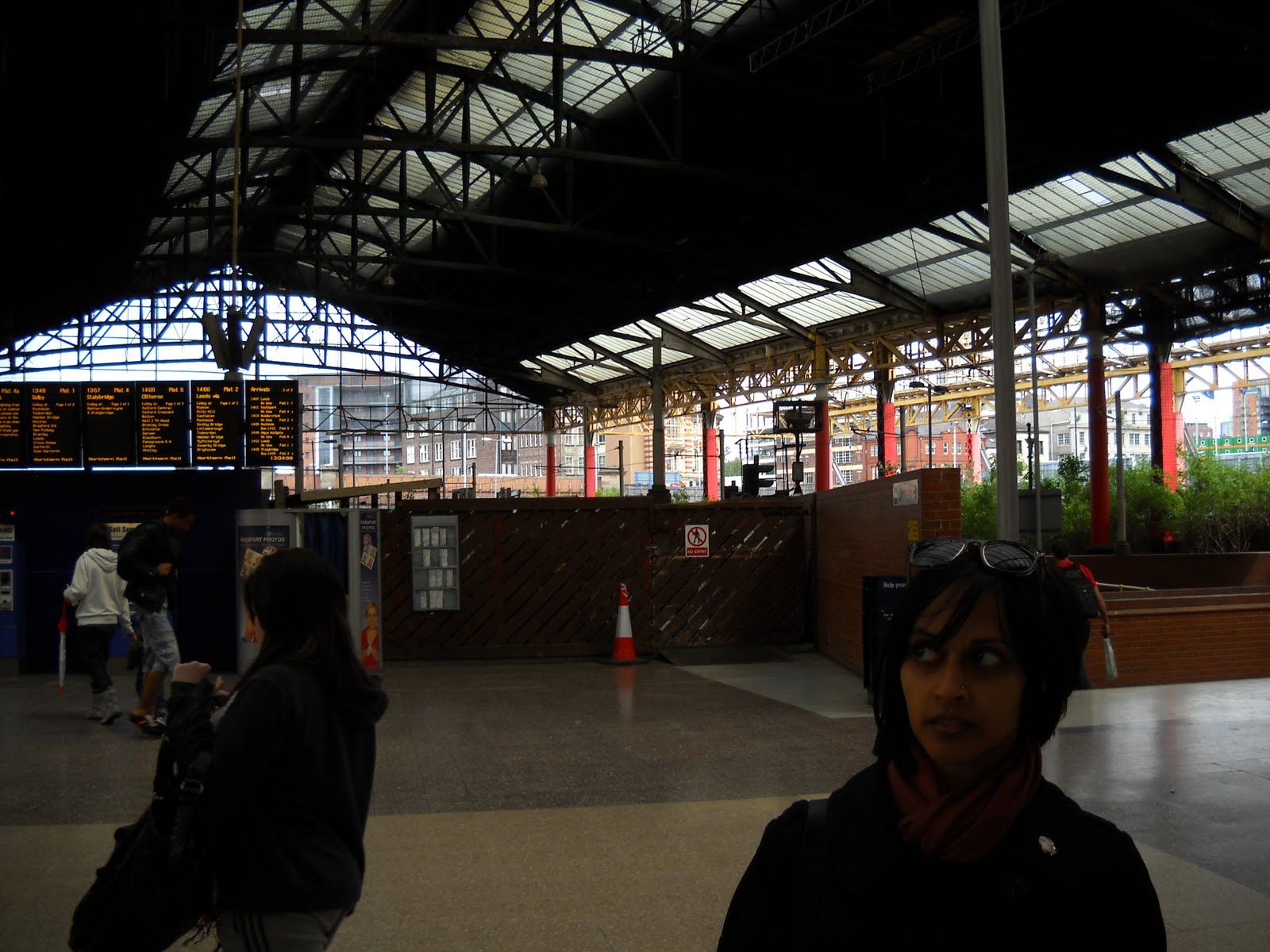
Just about a month ago, I traveled down to London to be an audience member on the Radio 4 Bookclub. I truly *heart* Radio 4. Sure it's got its problems. Maybe too much comedy radio plays. Maybe a few too many airings of the Archers. It's still my favourite radio station ever. I listen to it just about all the time. Except when I'm writing essays and have to concentrate. Then I listen to Radio 3.
Anyway, Radio 4 have a great bookclub series. They invite an author on, get some listeners to read the book, come in and discuss in a little studio. Having tried to get a radio bookclub going a few times in Sydney, it was exciting to be a listener/reader for this one... especially since the book being discussed was The God of Small Things and the author, Arundhati Roy, was going to be there!
I'd been a fan of Arundhati Roy's politics for years. She's a hero. But I hadn't read her novel until Monika gave it to me as she was moving to New Zealand. I was helping her pack up to leave Sydney that day, and my eye wandered over the cover.
"I've never read The God of Small Things," I said. "Whenever I tell someone I'm Indian, the first question I usually get is, 'Have you read The God of Small Things?' I feel like they don't think I'm a proper brown person when I say I haven't."
"Take it," Monika said, "My gift to you: you can be a proper brown person."
I'm lucky to have friends who know when I'm being funny and choose to play along.
So, I read the book. I wasn't all that impressed, honestly, and some of you may remember my review here.
Cut to me in Manchester on any random night, listening to Radio 4 and the rain, and at the end of that month's bookclub show, they invite listeners who want to be at a bookclub with Arundhati Roy to write in.
Good thing I can type fast like lightning. I wrote in. They wrote back. I got myself another copy of the book, because Monika's gift to me was still in Sydney, and I bought a ticket to London.
On June 6th, I was so excited about being in London, that I found myself walking down the street with a big stupid grin on my face, American-tourist-style.
"I'm going to be in a BBC building," I thought, "Oh, wow!"
To be fair, it wasn't raining or even foggy or cold, so I did have *quite* a lot to be happy about.
Some handsome young gentlemen who were walking hand-in-hand down the street saw my goofy smile and said, "Bonjour, mademoiselle!" I don't know why everyone in Manchester's always talking about how cold people are in London. Those two gay men seemed *lovely.*
I had a few hours to kill before the show, which was being taped in Bush House. Which just happens to be right near Covent Garden... which just happens to also have a Tatty Devine boutique. I love small coincidences. I dropped by and bought a new necklace (pictured below), and then wandered around, enjoying the Covent Garden cafes and streets. I found a truly wonderful bookbinder supply shop, and they even do mail-orders. FAB. And Charles Dickens once lived near here! London is so old and cool and interesting and overwhelming, I nearly passed out.
Finally, it was time to go to Bush House, and get in the studio.
Bush House is a gorgeous old building with winding corridors and marble stairwells and a courtyard. They sort of ushered us through very quickly, though, so I only got exteriors.
The studio itself was nothing to look at, but they did give us some free BBC wine. And I got to take a photo with Arundhati Roy, a proper brown woman if ever there was one, by my account.
The bookclub taping went well, and I even got a question in! But of course, I don't know if it'll end up in the final edit of the show. It won't go to air until October– don't worry, I'll put a link up when it does, especially if my question makes the cut!
I left the studio and headed back toward the train station, still beaming and thrilled to have met Ms. Roy, and been in a BBC studio. It was just a lovely day altogether.
And lest you think that's the end of the story, dear reader, read on:
For those who haven't been on an British rail train, the seating on the trains here works like airplanes. As in, you get assigned a seat when you buy a ticket, you sit next to some stranger.
I found my reserved seat, pulled out my computer, and started watching some This American Life: The TV show. Some guy sat next to me, and as you do in airplanes, we nodded at each other. Made short comments throughout the train ride. Near the end, I muttered, "Christ, it always feels longer coming back. I swear it didn't take this long this morning."
Stranger said, "You went into London and back in one day?"
I explained that I had to be in Manchester the next day, that I had a chance to meet Arundhati Roy, that it was worth it, even if it meant six hours of train in one day.
The train pulled into Manchester Piccadilly, and as we shuffled onto the platform, he asked if I wanted to get a drink. "Sure," I said, because I am adventurous and spontaneous, and because I trust this city to put amazing new people in my path. I will not turn them away.
His name's Mark, and he hates Manchester. Or at least he did then. I told him how much I love this city, and he looked surprised. When he told me why he hated it, I quickly diagnosed the problem. He had not been to the right places. He had not seen Chetham's, he had not been on a single history walking tour. He had not been to the Knott Bar. He had not made the right friends.
"It's your lucky day," I told him, "I am an *excellent* friend to have in this town."
Too late. He was leaving in three weeks, he said, to go back to Scotland, and then hopefully London.
As regular readers and my dear friends and family surely already know, I don't give up so easy.
I was determined to show him, in what little time he had left, that this town could be amazing. I should get paid by MCR tourism for this kind of work, seriously.
The upshot? He left for Scotland last week, but he's coming to visit soon. Another chance to convince another convert.
05 July 2011
26 June 2011
How to say what needs to be said?
Astute readers will have noticed the slight change in the title and header of this blog, from "Bad Pennies: They'll come back as soon as they're ready," to a more singular variety.
That is because, as of today, I am, as they say, on my own.
I started this blog when Craig and I moved to Australia, to keep in touch with Atlanta-based beloved people. And over the last three years, it has grown, and it has reflected nearly every shift in our lives.
And I have grown. And Craig has grown.
And we are no longer who we were when we set off on an adventure called Australia.
So, this blog will now reflect this shift in our lives.
We are each on our own.
Happier posts coming soon, I promise, dear dear readers.
That is because, as of today, I am, as they say, on my own.
I started this blog when Craig and I moved to Australia, to keep in touch with Atlanta-based beloved people. And over the last three years, it has grown, and it has reflected nearly every shift in our lives.
And I have grown. And Craig has grown.
And we are no longer who we were when we set off on an adventure called Australia.
So, this blog will now reflect this shift in our lives.
We are each on our own.
Happier posts coming soon, I promise, dear dear readers.
11 June 2011
On a clear day you can see to Penrith
My trip to Manchester wasn't all relaxation and train-station-based theatre, my friends, oh no. It was also a serious business trip that had me visiting the Photon Science Institute to have a stickybeak, meet prospective collaborators, give a presentation and paint myself as generally competent and good drinking company in case they feel like handing out postdoctoral appointments soon. And so on Wednesday we set out for the uni in classic Craig fashion, i.e., unsure of where the building is, exactly, and what it's called. Fortunately I had my contact's number written down and we didn't have problems. In short, the visit was very good, and my presentation was fine, and Nija, ever the fan of science, came along too, wearing her new T-Rex necklace. Nija sat down in the third row or so, amidst the people of the Institute.
Ensued a play:
UNTITLED
by CMJ
DRAMATIS PERSONAE
Geek
Nija
G: (smarmily, eyebrow cocked) Heh-looooo, are you a student at the Institute?
N: (chipperly) No, that's my sweetheart up there! The ginger!
G folds his arms and slumps into his chair.
N: So are you a student here? What do you do?
G: Nothing. It's complicated. Whatever. Mumbles.
Silence
Exeunt omnes.
A true slice of life! Oh well, can't win them all.
Anyhow, we set out after the visit to one of England's classic destinations, the Lake District (or possibly the Lakes District), famous for astounding scenery, quaint villagelets and rakish authors who died more than a century ago, like Wordsworth and Thomas de Quincey. It's about an hour north of Manchester, so in Sydney terms it's in metropolitan Manchester. We set out on our journey in classic Craig fashion, i.e., I had looked at the map (as we sat in the car before leaving) and kept telling myself the numbers of the motorways we needed to take, but didn't write it down as I thought "It's only two numbers, how can I forget?" Well, first we got stuck in traffic (or we participated in traffic, as it were) on the Ring Road for an hour just trying to get to the other side of town. Second, all the motorways leaving Manchester are sixty-something, so I just basically got mixed up between 61 and 66.
A good 30 minutes into our journey up the 66, the thing terminated and put us onto a surface street. I was trying to get to the M6. Something was amiss. Nija had to drag out the map, which she hates being responsible for, and I wound up agitated and not very friendly about getting us to the 61, so we could get to the 6. It wasn't pretty, and I was sorry, and I encourage you to write things down, reader, lest you wake your partner from a pleasant doze to give her bad news and then have her fix it.
We did get to the 61 (thanks, darling) and then to the 6, and then wound our way up past wind turbines and through lovely countryside into Cumbria and the hamlets of the Lakes. Fortunately, summer was on its way to the North and so it was light out until about 10PM---fantastic---so even though it took us twice as long to get there than expected and even though we'd left in mid-afternoon, we could still take in the epic landscapes and mirrored surfaces of the lakes, meres, tarns, sluices, estuaries, wassers, fjords, estanques, pozos, billabongs, and whatever else they call ponds up there in that part of the shop.
On a friend's recommendation, we planned to stay in Grasmere, a village about 20 minutes beyond Windermere, "the Katoomba of the Lakes". We got there and checked ourselves into a comfortable guest house, headed into the dark for a pub meal, then returned with wine.
Next morning we were surprised to find that someone had been making sacrifices to the god of good weather; despite the rainy week we'd had in Manchester we got one of the Lakes' elusive beautiful days. We packed up some of the food we'd brought from the city, had some breakfast, picked up some maps, and headed out according to one of them on a several-hour walk around Grasmere lake. Fifteen minutes later, we still hadn't gotten out of Grasmere, because we couldn't figure out where, exactly, the map was telling us to start. I suppose it was more of a set of vague instructions than a "map", per se. Eventually, thanks to the help of a kindly hotel receptionist, we were on the right track.
I don't know what to say about the walk, which was without incident. These pictures say it much more eloquently:


And so on!
Also featured were these guys:

It was indeed an excellent walk, and by the time we got back to Grasmere we were in need of some tea and cake, which fortunately were available at the tea and cake shop. Afterward we grabbed our car and toodled up toward Penrith, capital of the Eastern Lake District. We were hoping for a scenic journey, whatever the destination, and my choice of a tiny little squiggle on the map to get there paid off big-time, with some harrowing driving and frankly unbelievable views. It doesn't make for good blogging, though, since we didn't take pictures; we just sat agog at the immensity and diversity of the landscape, from green pasture-lined hills to sharp, craggy, dusty ranges, all in the span of a few miles.
We made it to Penrith in one piece. For our Australian readers, this is the original Penrith we're talking about here, and let me tell you that it's quite an honour to set foot in the place that inspired our own mountainside metropolis. One can see why some voyager might have longed for his home such that he decided to spawn a new one. There is a nice clock tower.
And note this in your travel journals: not a pub in Penrith has macaroni and cheese. We checked. But they do serve beer, and hot chips, and so we tucked in, and watched Obama give a speech without the sound on, and we headed back to Grasmere for a quiet night.
Ensued a play:
UNTITLED
by CMJ
DRAMATIS PERSONAE
Geek
Nija
G: (smarmily, eyebrow cocked) Heh-looooo, are you a student at the Institute?
N: (chipperly) No, that's my sweetheart up there! The ginger!
G folds his arms and slumps into his chair.
N: So are you a student here? What do you do?
G: Nothing. It's complicated. Whatever. Mumbles.
Silence
Exeunt omnes.
A true slice of life! Oh well, can't win them all.
Anyhow, we set out after the visit to one of England's classic destinations, the Lake District (or possibly the Lakes District), famous for astounding scenery, quaint villagelets and rakish authors who died more than a century ago, like Wordsworth and Thomas de Quincey. It's about an hour north of Manchester, so in Sydney terms it's in metropolitan Manchester. We set out on our journey in classic Craig fashion, i.e., I had looked at the map (as we sat in the car before leaving) and kept telling myself the numbers of the motorways we needed to take, but didn't write it down as I thought "It's only two numbers, how can I forget?" Well, first we got stuck in traffic (or we participated in traffic, as it were) on the Ring Road for an hour just trying to get to the other side of town. Second, all the motorways leaving Manchester are sixty-something, so I just basically got mixed up between 61 and 66.
A good 30 minutes into our journey up the 66, the thing terminated and put us onto a surface street. I was trying to get to the M6. Something was amiss. Nija had to drag out the map, which she hates being responsible for, and I wound up agitated and not very friendly about getting us to the 61, so we could get to the 6. It wasn't pretty, and I was sorry, and I encourage you to write things down, reader, lest you wake your partner from a pleasant doze to give her bad news and then have her fix it.
We did get to the 61 (thanks, darling) and then to the 6, and then wound our way up past wind turbines and through lovely countryside into Cumbria and the hamlets of the Lakes. Fortunately, summer was on its way to the North and so it was light out until about 10PM---fantastic---so even though it took us twice as long to get there than expected and even though we'd left in mid-afternoon, we could still take in the epic landscapes and mirrored surfaces of the lakes, meres, tarns, sluices, estuaries, wassers, fjords, estanques, pozos, billabongs, and whatever else they call ponds up there in that part of the shop.
On a friend's recommendation, we planned to stay in Grasmere, a village about 20 minutes beyond Windermere, "the Katoomba of the Lakes". We got there and checked ourselves into a comfortable guest house, headed into the dark for a pub meal, then returned with wine.
Next morning we were surprised to find that someone had been making sacrifices to the god of good weather; despite the rainy week we'd had in Manchester we got one of the Lakes' elusive beautiful days. We packed up some of the food we'd brought from the city, had some breakfast, picked up some maps, and headed out according to one of them on a several-hour walk around Grasmere lake. Fifteen minutes later, we still hadn't gotten out of Grasmere, because we couldn't figure out where, exactly, the map was telling us to start. I suppose it was more of a set of vague instructions than a "map", per se. Eventually, thanks to the help of a kindly hotel receptionist, we were on the right track.
I don't know what to say about the walk, which was without incident. These pictures say it much more eloquently:


And so on!
Also featured were these guys:

It was indeed an excellent walk, and by the time we got back to Grasmere we were in need of some tea and cake, which fortunately were available at the tea and cake shop. Afterward we grabbed our car and toodled up toward Penrith, capital of the Eastern Lake District. We were hoping for a scenic journey, whatever the destination, and my choice of a tiny little squiggle on the map to get there paid off big-time, with some harrowing driving and frankly unbelievable views. It doesn't make for good blogging, though, since we didn't take pictures; we just sat agog at the immensity and diversity of the landscape, from green pasture-lined hills to sharp, craggy, dusty ranges, all in the span of a few miles.
We made it to Penrith in one piece. For our Australian readers, this is the original Penrith we're talking about here, and let me tell you that it's quite an honour to set foot in the place that inspired our own mountainside metropolis. One can see why some voyager might have longed for his home such that he decided to spawn a new one. There is a nice clock tower.
And note this in your travel journals: not a pub in Penrith has macaroni and cheese. We checked. But they do serve beer, and hot chips, and so we tucked in, and watched Obama give a speech without the sound on, and we headed back to Grasmere for a quiet night.
05 June 2011
What is a train station?
Before Craig got here, a friend of mine asked me what Craig and I would do. I listed the knowns: spend time introducing Craig to my new friends, go to the Lake District, go to Mossley and see Acorn's Antiques. I said there were unknowns, too.
My friend said, "I thought you'd just spend all week in bed."
I laughed. "Right," I said, "We're not really that sort of people."
In the ten short days that Craig was in Manchester, we did many things. Some might say too many. For example: on his fabulously rainy last day, we went to the Manchester Art Gallery. But no one could possibly question Station Stories.
...
Piccadilly train station is, perhaps, not quite at the centre of the city, but it is Manchester's main train station. Its current incarnation was built in the 60s, and as such, it is an enormous glass structure. In its own way, it can be beautiful.
It is modern, with digital arrival and departure signs. 12 train platforms, as well as the Metrolink light rail platforms below. It is also a mall, housing Starbucks, Monsoon, TieRack, and the only Manchester branch of the enormous UK chain The Bagel Factory, which sells and promotes bagels as "America's best kept health secret!" Indicating, of course, a nearly complete misunderstanding of bagels, Americans, and more generally, perhaps more sadly, health.
...
But what is a train station? For the most part, I think, for most people, a train station is a waiting place. A place merely designed to take you from home to a place you want or need to be. It is a place you deal with, a place where you undergo sacrifice of time and pleasure, in order to get somewhere you would prefer to be. Or perhaps somewhere you have to be.
A train station is also a public place, where many people have private trajectories. Some are coming home, some are starting holidays. Some are leaving for work, some arriving from it. In many public places, everyone is largely doing the same thing, in restaurants, most people eat. But train stations are a special sort of public place, with special rules. You do not usually congregate in a train station. You pay 30p to use the restroom. There are special rules.
And for the most part, I think, for most people, not a lot happens in a train station. It is a waiting place. It is a getting from here to there place. It is just an in-between place.
Sure it is a shopping place, too. But only as a product of waiting. You wouldn't go to the train station to shop. You would shop there only because you had to wait there. It is a drinking and eating place, as well, but again. Only because of the waiting. **
Now imagine this:
Approximately 12 strangers stand on the mezzanine of Piccadilly Station, looking down at the ground floor. Imagine you are watching the amorphous crowd. You stand, watching, picking out individuals as they make their ways through the station. This one has an enormous backpack. Maybe she's on her way to the trip of a lifetime. Maybe she's just returned from it. Maybe, just maybe, you think, Manchester is part of it.
Now imagine this:
You and approximately 11 strangers are not only standing on a mezzanine and watching. You are all also wearing headphones, making you look, if anyone cared to look, like a group of very special people.
See what I mean?
Regardless.
In the headphones, you hear ambient music, sounds from around the train station. You can also hear muffled announcements, fighting their way into your ears, despite the headphones.
And then you hear a man's voice, very nearly inside your head, telling you the story of the girl he met, loved and lost at the train station.
You hear him, but you do not see him. He is one of the crowd.
And because you cannot see him, he could be anyone. These thoughts, this story you're hearing, they could be anyone's. Because a train station is a waiting place, that makes it also, strangely sometimes, a thinking place. And any of these people you're watching could be thinking this. Something like this.
Eventually, if you pay attention, he makes himself known. He wanders through the crowd, speaking quietly into a wireless microphone, and though you are 50 feet away, you can hear him just as you could if he were in your bed, telling you everything he'd been through with that woman. It feels like he's talking to you.
Really, he's talking to you. And approximately 11 strangers.
He told us his story, about how she wrote him cards, and how he needed to get rid of them, now that she wasn't his any longer. He tries leaving them around the station these days, he says, but it's hard. People are always noticing, giving them back to him. "Hey, mate! You dropped this!"
And as in his story, so in real life. You and approximately 11 strangers are the only ones, you see, who know he's trying to drop these things. And you are unnoticed. You are 50 feet away. There are many people in this train station who are there merely to wait, and they do what people do. Mostly, they do not notice. They do not notice him dropping his love letters, and they do not notice approximately 12 strangers watching them, with headphones on. But some do notice.
"Hey mate," they say, in entirely good faith. "You dropped this!"
He takes the card back, and thanks them for noticing, and continues telling his story and drops the card again.
And you stand there on the mezzanine and listen to this private story unfold. You watch and hear this performance, performed for an intimate audience: only you and approximately 11 strangers.
Is a train station, then, a private place?
Or is a train station, then, a theatre?
...
We heard six stories that day, performed by six writers. They performed at different parts of the station, and we walked to varying areas to hear and sometimes see them.
David Gaffney, Nicholas Royle, and Jenn Ashworth were especially memorable, perhaps only because I had already heard of those writers. Or perhaps because I could, in some way, relate to the stories they told.
There was a very obscure sort of poetry by Tom Jenks that was difficult to hang onto because I could not read his words as he said them, and his words were sometimes tricks, as poems can sometimes be. There was a conspiracy tale about the Masons.
Their stories were live-mixed with music and sounds from around the train station. Very cool technology was used to transmit the live-mix to our headphones.
It was futuristic. No. It was the future. I think this because Station Stories, in a way, raised almost too many questions for it not to be the future.
Architectural questions.
For example:
What is a train station?
When you really start thinking about them, they are truly strange places. They are never fully closed, so there is never really an "inside." They have doors that demarcate inside and outside for people. But the doors for the trains are always open to the outside. Perhaps it makes sense for them to mix public and private like this, to be so ambiguous.
Dramatic questions.
For example:
What is a stage?
For Station Stories, the thoroughfares were the stage, sometimes. And sometimes the dead spaces of the station were the stage.
Ethical questions.
For example:
Is it ok to have people to unintentionally become part of a performance against their knowledge and/or will? Or where is the line between art and life, and are we allowed to find them and trample on them in this way? Are we not allowed? Who lays down those rules?
Anthropological questions.
For example:
What is a performance? And who are performers?
The writers, surely, were performing. Traditionally. But what of the strangers who didn't know what was going on, and yet still played by the special rules of the train station, by refusing to let a man drop a card and keep walking? What of them doing what was expected? What of the others who ignored the cards, who didn't notice the cards? What of them doing what was equally expected?
And more to the point and to the problem questions.
For example:
What of us?
Occasionally people pointed up at the mezzanine, alerting their family to our presence, laughed at the specials, or just looked confused in our direction. We looked back, sometimes. That, too, was that a performance?
....
Of course, individual lives and stories and trajectories are going on everywhere all the time. Only a solipsist could imagine otherwise.
But Station Stories made it art, made it high-tech, and because of the excellent writers, it was damn engaging, too. Craig said I had this face on the whole time:
Which is too bad, because I feel like I look rather stern and unhappy in that picture. Just about angry.
"No," he said. "That's what you look like when you're thinking."
Oh, dear. I might need to stop thinking so much, if that's how I look, I said.
And he said something sweet, like he does, because he's that sort of person. It was, undoubtedly, loving. The kind of thing he says all the time that I forget quite easily. I'm that sort of person.
...
Two days later, we were back at Piccadilly, this time having a private story of our own in that very public space. He was leaving again, and this time I won't see him for probably a full year, unless we manage something magical. He probably did, but I can't remember if he told me this time that I look beautiful.
I don't remember the right things sometimes. I'm that sort of person.
....
**
This is a footnote, added mere hours after this post was published.
I have twice been in train stations when they became not waiting places.
The first:
Years ago in Atlanta, I was on my way to a protest against an abomination that is otherwise known as war. I was traveling on MARTA, which is an abomination in itself. I tell you what, it is not "Smarta."
Having cleverly deduced that a truly massive horde of protestors (maybe 30 people?) were using public transit to attend the protest (because, I suppose, we were holding placards and banners that said, sometimes, "No Blood for Oil"), the cops shut MARTA down to prevent us joining the massive horde that was already at the protest location. Which is to say, our combined might would have equalled that of... well, maybe 100 people. Protesting isn't that big in Atlanta. We were already on the train, and we were only a few stops away, but now we were locked in.
And someone started singing. Not some obvious protest song, not Woody Guthrie or Bob Dylan. Not Joe Hill. Oh, no. No, no.
Someone started singing, and we all joined in. I found myself, with maybe 50 other people, singing loud...
Take my hand, we'll make it, I swear!
O-oh! We're halfway there!
O-oh! Living on a prayer!
I present for your judging eyes, then, dear readers: Bon Jovi as a transformer of space.
The second:
Craig and I waited on the platform, just a few weeks ago, for the train that would arrive and a few minutes later, take him away. We said our goodbyes, the train rolled in. And rather than him quietly taking his seat, we were overwhelmed by 100s of laughing, cheering, partying, screaming people streaming out of the train.
Man City had just won the FA cup. City fans made the train, the train station, the streets into a place of pride.... Craig's train left with him on it, and I followed the party into the train station and out of it, laughing and taking heart in the collective joy that filled the train station.
28 May 2011
Manchastic! Er...Manchesterrific? (Part II)
Day Two of my Manchester visit took us to the Victoria Baths, a beautiful disused bathhouse near Nija's place:

Therein we expected to find a 'zine fair'. 'Zines' (zeens) if you don't know, are basically small-run, independently-produced, often hand-made booklets or magazines, usually focusing on art, poetry, short stories, music, subcultures involving those things, or just weirdness. It's actually a really hard-to-describe concept, now that I think about it. It boggles the mind how many of these things must have been put out over the years around the world. Actually, the fact that they're called something in particular, and not just 'books' or 'magazines', says something about modern publishing. As usual, the Wikipedia entry is worth looking at. I could probably drone on and on about them, but that's not the point here.
Point is, we went in and found that the fair was part of the FutureEverything festival's 'Handmade' event and included some installation 'kinetic art' pieces called Physical Oscillators by Antony Hall:
Amazing!
There were zines indeed, and vegan baked goods, and weird arts/crafts/science projects, and so on. Nija found out about a community laser milling outfit that will cut all kinds of stuff out of plastic, metal etc for you if you give them a design, I presume for free or very little dough, much like Sydney's Rizzeria is meant to do for people needing high-quality colour printing. (PS: Check out news about the MCA Zine Fair in Sydney this past weekend on the Rizzeria wesbite. What the weird?! Must be that time of year.)
That evening we had a hot date with Nija's friends Michael and Bernadette, who live in the lovely little Tameside town of Mossley, a 20-minute trainride to the Northeast of Manchester. We headed up to Victoria Station to get a train but just missed ours and had an hour to kill. Victoria is a fine old place, with a classic look (see yesterday's post) and a great tile mural near the entrance:

Something about those lists of sea destinations to the east just takes my breath away.
So with our spare hour Nija and I decided to tuck into our first pints of the day at the station pub. Fortunately they also served nachos, which Nija prescribed to me as part of my 'fattening-up' diet. Now let me tell you something: I've never eaten nachos in a train station before, and I did that day. And they were not the best nachos ever, but they were also not the worst. And there I shall leave it.
The plate of nachos almost cleaned entirely, we got our train, which was full and wound up getting hung at some point along the journey due to a failed train up ahead. It was amazing how nearly everyone on our car went to sleep as a response. Nija dozed off, I fought bravely but probably had a wink, and all those around us just lapsed into comas as though the train were filling with its own exhaust. We got moving again, but the trip to Mossley took us twice what it should have, I'm told.
The purpose of our journey was that we had tickets to a Mossley theatre company's production of Acorn Antiques, Victoria Wood's soap-opera spoof about a small-town ('Manchesterford') antiques shop and the grotesque caricature-people involved with the place. The play is based on a regular segment of her 80s TV series Victoria Wood As Seen on TV, but it's a musical. The main characters are there, but the play features all mod cons, such as mobile phones.
After a pleasant visit to Michael and Bernadette's place and some excellent homemade pizza and salad, we walked up to 'Top Mossley' for the show. This just happened to be the final show of the run, and so the community centre was packed. We were all worked up, looking forward to a classic small-town theatre production, as you do. We wanted crappy sets, flubbed lines, dazed performers. Something to chortle over when we got home, don't you know. The schadenfreude of the city-dweller.
And we were resoundingly disappointed.
The sets were very competently-built and didn't collapse once. The lead actors were probably all professionals. Even the obviously non-professional cast members were good. The orchestra was top-notch, and the singing and dancing were quite fine (especially the surprise group tap-dance number). Worst of all, it was hilarious. And I mean the kind of hilarious that you're allowed to laugh at!
We were told we wouldn't get most of it, not being from Britain, but I think we actually cottoned on to quite a bit of it. Broad, crude humour seems to easily surmount whatever national boundary it encounters. It was especially gratifying to see all the old folks guffawing at the jokes about sex and bowel movements. Fantastic! And some of the utterly ridiculous plot elements were just undeniably charming and smart. One character has a cellphone that he says will play 'Daisy, Daisy' if it's his mum's nursing home calling to say she's passed on. Sure enough, it does.
Actually, it seems the play captured the old show's brilliant irreverence really well. Check out this episode from 1990:
It makes me realise that all the professionalism might have actually been completely misplaced. Perhaps what we saw was actually a bad show after all! Note the deliberateness with which Acorn Antiques was meant to look like a low-budget soap opera. In this episode the exterior fly is waving around in the breeze, the actors flub and miss their blocking and cues, the boom mics and cameras dangle into the shot, and Julie Walters almost walks into the audience. Like I said, in Mossley, no one screwed up, the sets were perfect, and everything went off without a hitch!
Silly small-town people.
Next time: the Lakes!

Therein we expected to find a 'zine fair'. 'Zines' (zeens) if you don't know, are basically small-run, independently-produced, often hand-made booklets or magazines, usually focusing on art, poetry, short stories, music, subcultures involving those things, or just weirdness. It's actually a really hard-to-describe concept, now that I think about it. It boggles the mind how many of these things must have been put out over the years around the world. Actually, the fact that they're called something in particular, and not just 'books' or 'magazines', says something about modern publishing. As usual, the Wikipedia entry is worth looking at. I could probably drone on and on about them, but that's not the point here.
Point is, we went in and found that the fair was part of the FutureEverything festival's 'Handmade' event and included some installation 'kinetic art' pieces called Physical Oscillators by Antony Hall:
Amazing!
There were zines indeed, and vegan baked goods, and weird arts/crafts/science projects, and so on. Nija found out about a community laser milling outfit that will cut all kinds of stuff out of plastic, metal etc for you if you give them a design, I presume for free or very little dough, much like Sydney's Rizzeria is meant to do for people needing high-quality colour printing. (PS: Check out news about the MCA Zine Fair in Sydney this past weekend on the Rizzeria wesbite. What the weird?! Must be that time of year.)
That evening we had a hot date with Nija's friends Michael and Bernadette, who live in the lovely little Tameside town of Mossley, a 20-minute trainride to the Northeast of Manchester. We headed up to Victoria Station to get a train but just missed ours and had an hour to kill. Victoria is a fine old place, with a classic look (see yesterday's post) and a great tile mural near the entrance:
Something about those lists of sea destinations to the east just takes my breath away.
So with our spare hour Nija and I decided to tuck into our first pints of the day at the station pub. Fortunately they also served nachos, which Nija prescribed to me as part of my 'fattening-up' diet. Now let me tell you something: I've never eaten nachos in a train station before, and I did that day. And they were not the best nachos ever, but they were also not the worst. And there I shall leave it.
The plate of nachos almost cleaned entirely, we got our train, which was full and wound up getting hung at some point along the journey due to a failed train up ahead. It was amazing how nearly everyone on our car went to sleep as a response. Nija dozed off, I fought bravely but probably had a wink, and all those around us just lapsed into comas as though the train were filling with its own exhaust. We got moving again, but the trip to Mossley took us twice what it should have, I'm told.
The purpose of our journey was that we had tickets to a Mossley theatre company's production of Acorn Antiques, Victoria Wood's soap-opera spoof about a small-town ('Manchesterford') antiques shop and the grotesque caricature-people involved with the place. The play is based on a regular segment of her 80s TV series Victoria Wood As Seen on TV, but it's a musical. The main characters are there, but the play features all mod cons, such as mobile phones.
After a pleasant visit to Michael and Bernadette's place and some excellent homemade pizza and salad, we walked up to 'Top Mossley' for the show. This just happened to be the final show of the run, and so the community centre was packed. We were all worked up, looking forward to a classic small-town theatre production, as you do. We wanted crappy sets, flubbed lines, dazed performers. Something to chortle over when we got home, don't you know. The schadenfreude of the city-dweller.
And we were resoundingly disappointed.
The sets were very competently-built and didn't collapse once. The lead actors were probably all professionals. Even the obviously non-professional cast members were good. The orchestra was top-notch, and the singing and dancing were quite fine (especially the surprise group tap-dance number). Worst of all, it was hilarious. And I mean the kind of hilarious that you're allowed to laugh at!
We were told we wouldn't get most of it, not being from Britain, but I think we actually cottoned on to quite a bit of it. Broad, crude humour seems to easily surmount whatever national boundary it encounters. It was especially gratifying to see all the old folks guffawing at the jokes about sex and bowel movements. Fantastic! And some of the utterly ridiculous plot elements were just undeniably charming and smart. One character has a cellphone that he says will play 'Daisy, Daisy' if it's his mum's nursing home calling to say she's passed on. Sure enough, it does.
Actually, it seems the play captured the old show's brilliant irreverence really well. Check out this episode from 1990:
It makes me realise that all the professionalism might have actually been completely misplaced. Perhaps what we saw was actually a bad show after all! Note the deliberateness with which Acorn Antiques was meant to look like a low-budget soap opera. In this episode the exterior fly is waving around in the breeze, the actors flub and miss their blocking and cues, the boom mics and cameras dangle into the shot, and Julie Walters almost walks into the audience. Like I said, in Mossley, no one screwed up, the sets were perfect, and everything went off without a hitch!
Silly small-town people.
Next time: the Lakes!
26 May 2011
Manchastic! Er...Manchesterrific? (Part I)
Call it what you will, Manchester is a fine little place. A "mini-Melbourne", I go around saying, as if I've hit on some kind of meaningful nugget of a phrase, when really it's a creaky parochialism if ever there was one. Or maybe that prize should go to "a maxi-Erskineville".
But Manchester is indeed Melbournesque: it's flat, has trams, has buildings from the 1800s, it's "cold", it has nice little bars and cafes, it has wild mobs of rival football fans roaming around, and so on. So here in Sydneytown, when the hipsters look at me askance when I mention Manchester, I just pounce on them with the morsel of truthful analogy-drawing above, and watch the jaws drop. They expect industrial wasteland, and I present them with the notion of a sophisticated playground for the epicurially-inclined. Though I'm not sure how the Manchester Egg fits into that algebra.
Of course, all those benefits pale in comparison---for me, anyway---to the one thing that Manchester, and only Manchester, can claim (and it's not the damn Egg):

No, not the Victoria train station either. I mean, that's nice and all, but I'm talking about the Nija in the lower right-hand corner. She's quite a resource to boast, and any city would be lucky to have her. Of course, she withdrew that honour from Sydney back in June 2010, and ever since then her absence has been noted up and down our long and ragged shoreline.
For me, of course, her departure was particularly tough, as we had for so long gone about as a pair. We came to Sydney two wide-eyed foreigners with very little to our names and only each other to hold on to. When she left after two years, everything changed.
And after dropping her off in Manchester in September of last year, like any good academic I signed up for the next reasonable conference within a few hundred km. Coming from Australia, this is a great scam that allows the Boss to pay for the big ticket airline fare, then the Worker shells out a few peanuts for a local flight. And that's why it makes sense to spend 100 years in school like me!
(Just kidding, Bosses. I hope you know that I considered the conference that you organised to be pretty important. And thanks for the airfare.)
Fortunately, this big-deal conference was in France, in Nice even! A beautiful spot and a 2-hour flight from London (which is a ridiculous ~35-minute flight from Manchester). Long story short, I busted my keister for months getting stuff ready for the conference. I went, had a great time, met some important folks, and got inspired. How could you not, in a conference centre that looks like this:

that's across the street from this?:

Ah France! Such a smörgåsbord of the awful and sublime! (Please note that because of European unification it is now legitimate to mix enthoculinary metaphors as demonstrated in the previous sentence.)
Nice was rather resplendent and is just downwind from Cannes, where at the same moment cinema royalty was agglomerating for its yearly gorging. I can see why they chose May over, say, December for the film festival. (Terrence Malick won the Palme d'Or, by the way, for his very dubious-looking Tree of Life.) I didn't see any famous types, but I did pay €50 for a 10-minute cab ride, so I felt famous.
After I was all conferenced-out, I headed for Manchester via London. Coming in to the Manchester airport my seatmate and I were gazing morosely out the window at the sopped tarmac, the cloudy sky, and the airport workers all bundled up, in mid-May mind you. "Look at that," he groaned. "Lovely!" I chirped. "You're joking, this is grim," he chided. And he was from Glasgow.
My bag, when I got it off the belt, reeked of €24 organic wine, just like the stuff I'd bought in Nice before leaving and stuck haphazardly into my bag. I sensed a connection, which was confirmed when I opened the bag to find one of my wine bottles broken cleanly in half. The contents had dumped out into the bag, but after some inspection it seemed that not everything was wet, which told me that the bag must have been inverted with the wine near the "bottom" so that, hopefully, someone else's bag caught the brunt of it. Maybe it was that person who was clearing his throat incessantly during the flight. I hope so.
I grabbed the train to the city, and as we toddled along in the Manchester exurbs, I noticed an undeniable anxiety that told me that I had changed, that she had changed, that I wasn't ready for this reunion. That maybe she didn't want to see me that much. That things just wouldn't be right.
Before long the buildings started to look familiar: Beetham tower, the wheel, and the other prominent bits of the Manchester skyline. And I got to the Piccadilly Station, where I expected her to be. And she wasn't there. Anxieties more than confirmed!
Did I have the wrong station? How did I mess up? I looked for a phone, dug for change, found none, got frustrated, and just turned on my phone and called. She was late, she apologised, because the website said my flight was delayed. She was on the way.
And I sat on a bench and waited, and eventually saw this person come in across the lobby, a person whose being has occupied so much of my attention for the last decade but who has lapsed from my little physical universe, becoming only an image on a screen, a voice through a speaker, words on a page, a memory, a hope.
She was real, and she was looking for me, and she hugged and kissed me, though I probably smelled of wine. She took me to dinner, and all was well in the Dirty Old Town.
More to come...
But Manchester is indeed Melbournesque: it's flat, has trams, has buildings from the 1800s, it's "cold", it has nice little bars and cafes, it has wild mobs of rival football fans roaming around, and so on. So here in Sydneytown, when the hipsters look at me askance when I mention Manchester, I just pounce on them with the morsel of truthful analogy-drawing above, and watch the jaws drop. They expect industrial wasteland, and I present them with the notion of a sophisticated playground for the epicurially-inclined. Though I'm not sure how the Manchester Egg fits into that algebra.
Of course, all those benefits pale in comparison---for me, anyway---to the one thing that Manchester, and only Manchester, can claim (and it's not the damn Egg):

No, not the Victoria train station either. I mean, that's nice and all, but I'm talking about the Nija in the lower right-hand corner. She's quite a resource to boast, and any city would be lucky to have her. Of course, she withdrew that honour from Sydney back in June 2010, and ever since then her absence has been noted up and down our long and ragged shoreline.
For me, of course, her departure was particularly tough, as we had for so long gone about as a pair. We came to Sydney two wide-eyed foreigners with very little to our names and only each other to hold on to. When she left after two years, everything changed.
And after dropping her off in Manchester in September of last year, like any good academic I signed up for the next reasonable conference within a few hundred km. Coming from Australia, this is a great scam that allows the Boss to pay for the big ticket airline fare, then the Worker shells out a few peanuts for a local flight. And that's why it makes sense to spend 100 years in school like me!
(Just kidding, Bosses. I hope you know that I considered the conference that you organised to be pretty important. And thanks for the airfare.)
Fortunately, this big-deal conference was in France, in Nice even! A beautiful spot and a 2-hour flight from London (which is a ridiculous ~35-minute flight from Manchester). Long story short, I busted my keister for months getting stuff ready for the conference. I went, had a great time, met some important folks, and got inspired. How could you not, in a conference centre that looks like this:

that's across the street from this?:

Ah France! Such a smörgåsbord of the awful and sublime! (Please note that because of European unification it is now legitimate to mix enthoculinary metaphors as demonstrated in the previous sentence.)
Nice was rather resplendent and is just downwind from Cannes, where at the same moment cinema royalty was agglomerating for its yearly gorging. I can see why they chose May over, say, December for the film festival. (Terrence Malick won the Palme d'Or, by the way, for his very dubious-looking Tree of Life.) I didn't see any famous types, but I did pay €50 for a 10-minute cab ride, so I felt famous.
After I was all conferenced-out, I headed for Manchester via London. Coming in to the Manchester airport my seatmate and I were gazing morosely out the window at the sopped tarmac, the cloudy sky, and the airport workers all bundled up, in mid-May mind you. "Look at that," he groaned. "Lovely!" I chirped. "You're joking, this is grim," he chided. And he was from Glasgow.
My bag, when I got it off the belt, reeked of €24 organic wine, just like the stuff I'd bought in Nice before leaving and stuck haphazardly into my bag. I sensed a connection, which was confirmed when I opened the bag to find one of my wine bottles broken cleanly in half. The contents had dumped out into the bag, but after some inspection it seemed that not everything was wet, which told me that the bag must have been inverted with the wine near the "bottom" so that, hopefully, someone else's bag caught the brunt of it. Maybe it was that person who was clearing his throat incessantly during the flight. I hope so.
I grabbed the train to the city, and as we toddled along in the Manchester exurbs, I noticed an undeniable anxiety that told me that I had changed, that she had changed, that I wasn't ready for this reunion. That maybe she didn't want to see me that much. That things just wouldn't be right.
Before long the buildings started to look familiar: Beetham tower, the wheel, and the other prominent bits of the Manchester skyline. And I got to the Piccadilly Station, where I expected her to be. And she wasn't there. Anxieties more than confirmed!
Did I have the wrong station? How did I mess up? I looked for a phone, dug for change, found none, got frustrated, and just turned on my phone and called. She was late, she apologised, because the website said my flight was delayed. She was on the way.
And I sat on a bench and waited, and eventually saw this person come in across the lobby, a person whose being has occupied so much of my attention for the last decade but who has lapsed from my little physical universe, becoming only an image on a screen, a voice through a speaker, words on a page, a memory, a hope.
She was real, and she was looking for me, and she hugged and kissed me, though I probably smelled of wine. She took me to dinner, and all was well in the Dirty Old Town.
More to come...
11 May 2011
Orfortress of Solitude
This past March, I was on empty, desolate Orfordness, bewildered, looking at these shards of glass that fell from who knows where, into an inadvertent sculpture. Yes, this blog post is way overdue. Anyway: at that moment, the nerdy pun that makes the title of this post popped into my head, and I laughed at myself. Dorky joke, I thought, and went looking for other things to bewilder me and take photos of.
...
Orfordness is a spit off the southeast coast of England. A spit, for those of you not in the geographical know, is a tiny peninsula, a long thin geographical toothpick of a peninsula. Orfordness, importantly, is a shingle spit. For those of you not in the geological know, "shingle" is basically pebbles. Orfordness, then, is a tiny little peninsula mostly made of and covered with pebbles. Excitingly, Orfordness is a vegetated shingle spit. And for those of you not in the know, vegetated shingle spits are incredibly rare on our wild planet. And Orfordness is the biggest one ever, at about 2,300 acres.
Having learned this, you will no doubt be surprised to find I wasn't on Orfordness to continue my internationally-renowned geomorphology research. Rather, I was there to do anthropology work with my Documentary and Sensory Media course, on a field trip.
"You said," I can already hear you say, "you said Anthropology is the study of people and cultures and stuff. Why are you on this field trip to this (admittedly very exciting) vegetated shingle spit that no one lives on??"
Because, dear readers, because I have not told you all. Throughout the three major wars of the 20th century, Orfordness was the British military's testing ground and engineering facility. The British army worked on radar there during WWI, and on the atomic bomb during WWII. The Cold War saw more nuclear research, for decades, Orfordness was the hub of Britain's military technologies.
Oh, yes. Locals call the spit "the island." It's not geographically correct, but since local knowledge trumps all, it is correct to call Orfordness "the island." And after the Cold War, the military abandoned the island, taking all their records with them, and leaving just their buildings and rubbish behind.
Surprisingly, the National Trust purchased Orfordness. The National Trust is a non-profit organisation that mostly preserves and looks after stately homes and large former aristocratic estate lands. They are very well-known for keeping pretty grounds, lovely for a picnic, and keeping beautiful old houses in their intended condition. Anyone can go to National Trust properties, and if you're a member, it's cheaper or free or something.
They are a preserving organisation, they are the preserving angels.
But the military had left no record of what the buildings on Orfordness were used for, or how. No records of which rooms were offices and which were testing facilities. Why are those holes in the wall? No one really knows.
And the National Trust was faced with a strange problem: how can you preserve something without knowing what it looked like before you got there, what it was supposed to look like, and what it was used for? How many people used it? There are so many questions, and mostly only speculation to fill the gap.
So, the National Trust took a bold move and decided not to preserve it. They would let all the buildings fall apart and decay, because trying to preserve them would be pointless. Orfordness is a tiny city abandoned by people, and the National Trust are mostly just letting nature break it down. One National Trust employee sleeps on the island every so often, but no one lives there.
One of the buildings, Cobra Mist, is doing better than the others, because up until midnight Saturday March 26, Cobra Mist housed a BBC World Service Transmitter. There's a whole staff of engineers who work there everyday, so Cobra Mist is not really decaying yet. The World Service Transmitter was shut down due to cuts, and the switch was flicked, heartbreakingly, the weekend I was there.
The equipment that controls the transmitter is beautiful, old 70s-looking stuff, schematics seemingly drawn straight onto them.
This is one of my favourite photos from the entire trip.
A coursemate, Lee Gallagher, got a recording of it the evening before shut off.
Lee does lots of sound recording, especially surreptitious stuff around Manchester. He's a lovely guy, but he doesn't have a blog or podcast or website or pretty much any sort of internet presence, so if you're interested in getting more information about Lee and any of his recording, let me know. I'll get you in touch.
Cobra Mist is a giant bunker of a building, up on stilts filled with unused rooms. Some of these rooms have no windows, some have airlocks. Some have inexplicable lists drawn in chalk on the walls. We don't know why.
This room was completely light tight. I had to use a flash to get this shot.
Bits of rubbish line the halls, and there's no real telling how long it's been there.
We stayed overnight on the island, and spent the next day in blistering cold wind, with our cameras and our sound recorders, documenting in sound and image the abandoned sites of Orfordness, the crumbling buildings. The island was inhospitable that day, you truly felt that no one was supposed to be here.
The island is eerie. There's gray pebbles and grey sky, and everywhere you look, everything's collapsing. No one lives here. It's a rare place for England. Once settled, it doesn't seem like much gets abandoned here.
We walked around, trying to record something other than the wind, and something other than ourselves. The thing about Orfordness is... there's only the sound of the wind and the water washing against the shingle. The only other sounds we recorded were sounds we made, throwing rocks against walls, or singing in dark damp concrete bunkers, our voices echoing, arguing with other echoes.
I'm still not clear on how this particular project was anthropological. I think there are a lot of ways that sound can be used in anthropology. But because this place is so empty, so desolate, so left behind by people, recording sounds of it don't appear to be any more meaningful than sounds of wind and water anywhere. And if we're interested in documenting the fact that this place has been abandoned, then we shouldn't be recording sounds that we make. We should just record the silence and waves and wind. I don't know that the echoes of stones thrown at a concrete wall tell me anything about how people lived here or what this place was for or what it means to anyone now.
Regardless, I'm glad I went on this fieldtrip. Of course, we had a great time there, cooking dinner together and playing pictionary and hangman. We laughed and more than a few of us were completely flummoxed by the idea of recording wind. We had a good time, and we saw something few get to see.
I'm glad I've been to Orfordness. The place is so strange, mostly because you can tell it must have once been full of life. There was a time when Orfordness was the place to be. Hundreds of engineers, blowing things up, testing bombs, maybe blissfully unaware of the effects of radioactive material on human bodies. There must have been a bar, a curry house. It must have been one of the most lively places in Britain. And it wasn't that long ago.
When we were there, though, it was anything but carefree. These buildings are falling apart moment-by-moment, so they're dangerous to walk in. And the National Trust folks told us not to touch or pick up anything on the island. "This is the kind of place where, something might look like it's tar," they said, "We don't know if it's tar." Everything here could be radioactive, tainted with depleted uranium. There's just no telling.
Some things in these buildings look so twisted and tortured, you can't imagine nature alone has done this. But why would the military have done this? And why does no one still know?
Even though this is a National Trust property, they don't let everyone onto these parts of the island. We were there under the auspices of our professor, Rupert Cox, and his friend Louise Wilson, a sound artist, who was commissioned to produce artwork about Orfordness, and she joined our fieldtrip, as an advisor. Her work A Record of Fear is all about the island. Because of them, we had access to the dangerous wilderness of Orfordness.
I don't use that word lightly. Jackrabbits have taken over this island, they hopped madly away every time we stepped in a building.
This place is filled with mystery. Suffused with intrigue. What on earth were they doing? Did this building ever have a roof? We know that in some rooms they were vibrating the bombs, to see how much they could be shaken without spontaneously detonating. Some rooms seemed to be centrifuges. Other rooms had no handles on the outside, so you couldn't accidentally walk into one. The big secrets must have been there.
A de-commissioned nuclear bomb lies in a small museum dedicated to the island's history.
And everywhere, there are remnants of the past to remind you: you really shouldn't be here. You're intruding on the island. No one is supposed to be here.
And the more I think about this lonely island with its falling buildings, pregnant with secrets, the more I think that nerdy joke is a little bit apt. Because of what people did here, people are not supposed to be here now. And people are not here now. It's hard to imagine any one really living on Orfordness these days, with its bleak gray shingle, bleak gray concrete rubble, bleak gray sky and sinister black water. Orfordness today really is a fortress of solitude. Not the safe place of some Cold War-era superhero, whose own reputation as saviour is crumbling every moment. This place is past all that. Rather, it's a fortress that protects its own solitude, to keep its secrets safely held within its own fracturing structures.
Subscribe to:
Posts (Atom)